
June 02, 2026
25 Minutes
Guests: Kelly Gill
Tags: Pollinators, Habitat, Staff Guests,
We spend a lot of time talking about how we can create habitat for pollinators in yards, but there are other spaces too. So if you don’t have a yard or even if you do and you want to expand your impact, no problem! Today we are going to explore how to create pollinator habitat beyond your home.
Show Notes & Links
In this episode, we talk about creating pollinator habitat beyond home yards. Guest, Kelly Gill describes projects ranging from large agricultural restorations to small community plantings in parks, schools, gardens, and urban areas like New York City and Philadelphia. She suggests getting involved through native plant societies, pollinator pathway groups, local parks volunteer days, and community science, or by organizing local efforts at libraries, schools, and vacant lots, citing Philadelphia Land Care and New York City’s GreenThumb. Gill highlights Bronx community gardens that provide food, habitat, education, safe gathering spaces, and neighborhood benefits. She discusses challenges such as site-specific planning, weather, theft, and public misconceptions, emphasizing realistic goals and detailed plans.
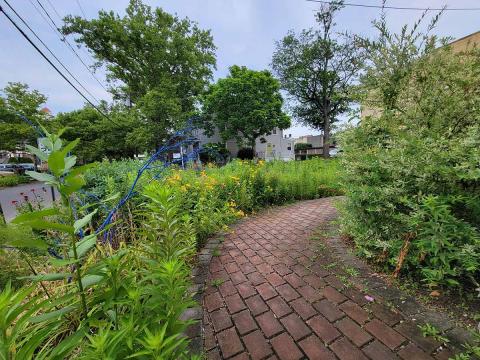
Episode image credit: Kelly Gill (c)
Matthew: Welcome to Bug Banter with the Xerces Society, where we explore the world of invertebrates and discover how to help these extraordinary animals. If you want to support our work, go to xerces.org/donate.
Rachel: Hi. I'm Rachel Dunham in Missoula, Montana.
Matthew: And I'm Matthew Shepherd in Portland, Oregon.
Rachel: We spend a lot of time talking about how we can create habitat for pollinators in yards, but there are other spaces, too. So if you don’t have a yard, or even if you do, and you want to expand your impact—no problem! Today we are going to explore how to create pollinator habitat beyond your home.
Rachel: Joining us to talk about this is Kelly Gill, pollinator conservation specialist and partner biologist with the USDA Natural Resources Conservation Service for Xerces. Kelly provides advice and support on planning, designing, installing, and managing habitat in the Mid-Atlantic and Northeast. Kelly also works with staff and research partners to develop technical guidelines and provide training on pollinator conservation practices.
Rachel: It's been a long time coming, Kelly. We're very excited to have you here on Bug Banter.
Kelly: I'm happy to be here. Thank you very much.
Matthew: I've been looking forward to this one. As Rachel said in the introduction, we're hoping that people who don't have a yard will get ideas and inspiration. You've worked for Xerces for 13 years, amazingly. Which is awesome. And during that time, you've been involved in creating habitat in so many different places. As different as downtown New York City, and the Bronx, and rural Pennsylvania. What a wealth of experience and knowledge to bring in and allow us to pick over, so thank you. Can you tell us about the variety of these projects?
Kelly: It's pretty magnificent. When I first started at Xerces, we didn't have so many staff in the East, so I got the pleasure of covering a large territory. Everywhere from New Jersey, to New York City, to coastal areas, all the way up through New England. So I've worked in a lot of different settings. I've worked on very large restoration projects, on agricultural land and land preserves. But also smaller plantings, smaller projects in communities, parks, schools, gardens. So it really has a huge variety across the years for all these different places that I got to learn about, and enjoy, and meet the people that are managing those areas.
Rachel: So when we talk about getting pollinator habitat put in for folks that maybe want to get outside of their own backyard, or don't have that space, what are some ideas and ways that people can get involved? And I just think about school gardens, or community gardens. What are some of those projects that you've worked on?
Kelly: Yeah. Yeah. Probably my first nine years at Xerces, and living where I do now in New Jersey—lived in a couple different places. They were apartments without yards, or I didn't have any control over any green space. Over the pandemic I moved to my rental that does have a yard, so I'm pretty excited about that. But ways I got involved—. There are a lot of people becoming more and more interested in native plant gardening, and gardening for biodiversity and pollinators, and just, you know, overall landscape resilience. And so getting in touch with your local native plant societies, your pollinator pathway groups, even your local park systems. You know, they have volunteer days where you can go out, do work, learn with them, see what's involved with creating some of these gardens, and habitats, and managing them. And kinda get a taste for it that way, and then maybe try to grow that effort in your community.
Kelly: Of course, if that's not your cup of tea, there's also plenty of programs out there that you get involved in, like community science programs. Xerces has several, and there's a lot more out there that help insects in other ways, getting more information and data about where they are, and their populations, and their status. So you could also be the leader in your own community, rally your friends up and find space—it's around—to propose projects like this. So libraries, schools. I live right outside of Philadelphia, so there are a lot of vacant lots like there are in many cities. I think about 40,000 vacant lots that are now being managed and greened for gardens. And so having those kind of local programs in cities—there's one in New York City, too—and those groups have a lot of different partners working together. And so it's also a great opportunity to learn from everybody's expertise, and just have that sense of accomplishment that you're doing something good for, not you, but the people around you, and the place you live. But yeah, there's a lot of opportunities out there, so you could keep yourself pretty busy. Haha.
Rachel: I think that's great. do you have a favorite project that you have been a part of, or one that's most memorable for you?
Kelly: I could say in all of those different areas that I've been working in, I probably have a favorite for each one. I don't know if I have a favorite exact location. But working within a community setting, in a community space where there are people working together, to meet that shared goal, and they're sharing the effort, as well. Some of this work may seem intimidating if you're doing it alone. And to kinda divvy up the tasks, and the labor, and the work, and playing to your own expertise, I think is important. It's just really nice to see how the people I've worked with in the community spaces have come together. They've made big changes in their neighborhoods that are really recognizable, and they've become spaces, not just for habitat, but for the community to gather in other ways, and enjoy access to nature and green space that they wouldn't have otherwise.
Rachel: Do you have any specific examples that you would like to share of different projects that you've seen in communities?
Kelly: Matthew mentioned some of the projects we've done in the Bronx. There's two gardens there that are a part of the USDA's People's Garden Initiative. And so they were already established community gardens growing food for local food banks and, you know, kind of starting off tackling food insecurity and food justice in these areas, bringing fresh fruit and vegetables to their neighborhoods. These spaces have grown into so many things. Like I said, just safe gathering spaces. They're often used for education. People come and just hang out. They're not just a natural refuge for the insects and animals we're trying to conserve, but for people. And they've done a lot of good for the community. So when you get those kind of compounding benefits, the food security, the providing habitat, and protecting natural biodiversity, safe gathering spaces. And there's studies that have shown when these vacant lots or areas are revitalized, crime goes down, there's less pollution, if it looks taken care of like a garden.
Kelly: And so I feel like that's just really important because there's just some kind of natural connection somebody has when they see something like that, versus something that looks more abandoned. And it just gives a sense of beautification to the neighborhood, and a sense of pride that is really special and meaningful. And you know, the long, long list of other benefits—mental health, and happiness, and all those good things. I think having all of those benefits packed into such a small space is just a really meaningful and purposeful way to do things.
Matthew: I remember reading about those projects in particular, Kelly, and they stuck in my mind as just relatively smaller area of land that has such massive benefit and huge impact on the community. And, as you say, in so many different levels.
Kelly: To give credit where credit is due—. With such a small part of what they are doing there. It's just really amazing to have been able to connect with them in that way. Very special.
Matthew: Definitely. With all these different projects I'm sure along the way there've been challenges, as well. Could you tell us a little about maybe some of the challenges and how you overcame them?
Kelly: No, no challenges for me. Pretty much 100% success rate so far.
Matthew: That's great. we can just move on then.
Kelly: Haha. Yeah, sure. There's always challenges. Sometimes what we're doing isn't easy. It takes a lot of work to get a space ready for planting, take care of the plants, teach people about the plants, what they're doing, trying to make sure that I'm also not just thinking about insects and plants like I usually am, but considering these individual goals of all of these different projects and the people I'm working with, which can vary. So the one most challenging thing is there's no cookie cutter recipe I could give somebody and say, "Here, do exactly this and it's gonna work out perfectly." And so having to consider, you know, all these site-specific factors and variation. It's challenging in a good way. And certainly there have been times, you know, you throw Mother Nature in and always expect the unexpected even though you think you thought of everything you could possibly think of. The weather doesn't cooperate, or there's some kind of event—a weather event that isn't very compatible with these establishing gardens, or it slows down the process. And so yeah, we've had things that we didn't expect, huge rainstorms that wash things away, or droughts, or, you know, we've had some really interesting things like plants be stolen from sites. Hopefully somebody just wanted them so bad and planted them somewhere else. I'm kind of okay with that. But, yeah, there's tons of challenges when you're working with a huge diversity of people. And you have to meet them where they are, but also get that job done in a meaningful way where you are meeting that goal—that conservation goal—that main goal that we have in our mission and our work.
Matthew: Yeah. No, definitely. And the only reason I'm asking is I'm just thinking of the perspective of our listeners. What information can we give them to help them overcome, you know, be aware of to plan ahead for some of the problems. Because, yeah, from my own experience, I know that even if you're a gardener, you think you know what's gonna happen, and you plant something and it doesn't grow.
Kelly: I'm ready to jump in and be like, “This plant is amazing! This insect—look at this!" But really the first thing I have to do is the unexciting part that's like setting expectations, making sure—. A lot of people have big ideas that are great, but they also have to be realistic and able to be accomplished. And so that's a huge part of it. And having a plan in place is just critical. You know, having your ideas, and your timeline, and your plant lists, and your list of supplies, and even down to like how much time and effort will this take me, and can I realistically do that? Because if people are like me and they wanna just jump right in—. Haha. And then, you know, along the way you're like, "Oh, I forgot to consider that. Oh, now I have to do this." And so thinking it through first—we all wanna get to the fun part of planting or gardening—but thinking it through is really important for the long-term success of these plantings. And I try to tell people, like doing it and very intentionally and with purpose is gonna help you in the long run make it a successful project.
Matthew: And just for fun what do you think is the most unexpected problem that you had to address?
Kelly: When you are in this field of conservation, and an entomologist or a biologist, people think you know everything about every animal on the face of the Earth. And we're still working on the million or so insects out there. So a lot of times, I don't have the answers. When I first started, I would get questions like, "Okay, yeah I wanna do this, but I don't want wasps in the garden. I don't want plants that are gonna attract wasps or bees." Having that educational talk about, “Okay, well, a lot of insects are gonna use these.” And so thinking that, you know, a lot of people are still learning about this concept, they're not familiar with it. And so taking a step back and saying, "If it's because you're scared of wasps, you know, here's why not to be." Squashing those misconceptions. I don't know, one of the most unexpected things—and it wasn't in a neighborhood, it was on a project on a cranberry farm—is that I got chased by an angry peacock. And I learned that day—I am not kidding—that peacocks are pretty, but they are—they're not happy birds. Somebody had it as a pet, and it got loose.
Matthew: But it's also the reality of some projects, isn't it? That's always—it’s always worth being aware of.
Kelly: It still makes me giggle [to] this day, because I wish I would've been outside of my body seeing this happen to me.
Rachel: Yeah, the peacock, I was not expecting you to say that, Kelly. Haha.
Kelly: I knew that you would not be. I knew that you would not be.
Rachel: When you're in the field, there are unexpected animals that can be a little scary. I did my master's work in Panama, and I was like, in the Panamanian jungle, and, you know, there were Fer-de-lance snakes and other things that could definitely like hurt you. But one of the transects I was doing was next to pastureland, and any time I was there the cows would just follow me, but they had these huge horns. Haha. And I just remember being so terrified of these cows every time. But I had to go slow and like observe, you know? That was the whole point of the transect. But I got back and my advisor just cracked up laughing because he was like, "So you went to Panama and the scariest thing were the cows?" It's just like you're at a cranberry farm and the scariest thing was a peacock chasing you, so thank you for that.
Rachel: So you had mentioned—touched on this earlier about ways that people can get involved. So for listeners who are not sure what direction to go, or they wanna get involved in their community, what would you recommend as their first step?
Kelly: Yeah. So I think, like I said, looking for the local—if there are any local groups working on these projects already, and getting involved. That's a great way to start, especially if it's a well-established, knowledgeable group. They probably have good leadership. They probably have a lot of resources to share, and knowledge. And then as a person that may be new to this, you could observe, "Oh, okay, this is—. Oh, this is something I could probably do," or, "This is something I might wanna do, in another space that I have in mind."
Rachel: I'm really intrigued by the abandoned lot idea. If somebody sees one in their community and they're interested in seeing if it's even a possibility to turn it into something more, what would they—like, how would they even get started with that? Who would they contact?
Kelly: Yeah. In Philadelphia, the Pennsylvania Horticultural Society has started—it's called Philadelphia Land Care Program with other partners. There was like 40 or 50,000 vacant lots. I think they've planted almost 8 to 9,000 of them over the years since I think they started in maybe 1990-ish. Or 1999. It was almost 2000. So there are analogous programs like that in other cities. New York City has the Green Thumb Program. There's a whole network of gardeners and gardening groups, actually. It's pretty amazing. And so those folks often work with city planners, and have funding and dedicated employees that help to run and manage these programs. And trying to look for something like that in your—where you are, in your space. And usually if you do see a revitalized lot—city lot—they'll have some kind of signage, as well. If you're thinking about starting something like that, if it doesn't exist where you are, there are a lot of good examples and models out there.
Rachel: Yeah. I think that's really exciting. Would it be outlandish for someone to contact their city planner if this didn't exist in their area?
Kelly: Not at all. Not at all. It would be outlandishly amazing because I think that—. I’ve been listening to these kind of city planning podcasts, which are very interesting, especially when they're on topics about, building resilience and green infrastructure, and things like that. And there's more than I ever knew that's already happening. And, you know, just hearing about that, and how that all works, and the improvements, and some of the struggles that came along with making those changes over time worked. It's pretty fascinating. So I think all city planners should already be thinking about that, and if they're not, maybe somebody might wanna put that bug in their ear.
Rachel: Love it. So are there any resources that you can recommend to people who are interested in any of these projects in general that we have?
Kelly: Yeah. So I mentioned earlier, our habitat kit program. The Xerces Society has a habitat kit program in several regions now. And that's a program where we provide curated groups of plants, and mixtures of plants in our kits, and signage, and instructions, and all the things you would need to plant a garden in exchange for—our partners, our habitat kit partners—to managing that space. So it helps us, you know, get more habitat on the ground. It helps them realize their goals. One of the challenges is access to native plant materials especially if you're in an urban area. And what plants to get? And where should I plant them? And how should I plant them? And, so that program is really great because it's like action right on the ground. And a lot of those sites are used for educational purposes, schools, things like that. And each region has some different rules, and it requires you to fill out a little proposal form, and explain your project. And we obviously get more requests than we can fulfill. So that means it's working. That's a really fun project to work on.
Kelly: Other than that, of course, the Xerces Society has a ton of great resources on our website for cities and towns, and neighborhoods and homeowners, and everything else in between, far and wide. And like I said, just reaching out, you know, there's native plant societies in every state. There's often multiple chapters, and they usually have good local resources on plant recommendations, nursery information, lists of nurseries that have pesticide-free native plants, particularly for pollinators. A lot of the master gardeners help out with that, so they have some experience and knowledge on their side, too, to help.
Matthew: Right. There are a lot of places where people can get help, and I always—. You mentioned the master gardeners. I always think master gardeners are worth connecting with. And you may well have a soil and water conservation district, or a resource conservation district—different names for different regions. And they could have advice and maybe even small grants.
Kelly: If there are, like, community farms and community gardens in your area. By the name of them, they're opened to the public a lot of times. And so asking the people who are already doing it and learning firsthand is a good way to develop your own library of resources and knowledge.
Matthew: That's very good advice, so thank you. I have enjoyed your tales of peacocks and gardens and it's been lovely to hear more about all the different things that you've been involved with and contributing to. We want to wrap up with just our last two questions. What inspired you to get into insect conservation?
Kelly: I was always—as many people are that are in this field—a child of nature. That's what I did. I was lucky enough to have a big backyard, and a creek, and some woods with trails. I was an only child, and I get bored really easily, so that was my main activity growing up. And doing artwork. I like to draw and paint. And so I actually—my first degree is in fine arts, and I got really interested in botanical drawing, and also, yeah, some life forms, and things like that, as well. So I'd be observing plants a lot, and then I would be seeing these little things that I just didn't sit still long enough to find or see in the past. And so I would wonder what that is, and then I got interested, and then I had to go to the library and look things up. And then I learned about the fascinating world, and all of these really complex interactions, and all of the super interesting and sometimes weird and wacky things insects do, and how they live, and I just became fascinated. It keeps me curious, and it always gives me something new to learn and think about. Because there's so many insects, you can't possibly get bored.
Rachel: I love that. I didn't know that you were an artist, Kelly. That's a really fun thing to learn. All right, so our very last question, and I'm very curious about this because we didn't really talk about insects very much today. We just talked about their habitat. So if you could see any bug in the wild, what would it be, and why?
Kelly: So, oh my gosh. I know. This answer will change probably by the day. One group of insects that maybe I haven't paid as much attention to have been the true bugs, and things like leafhoppers and planthoppers. And so I've really gotten actually into reading about different treehoppers. And so the tropical treehoppers that have the really pronounced pronotums, and they look very strange. And they do really interesting things. Some of them look like little thorns on a branch. And they have maternal care for their nymphs. They play little songs on the leaves. And so I've been going down that rabbit hole, and just looking at their form, and the different structures, and how silly and strange they look. It's just been fascinating. So that is what I'll say for this week's bug of the wild that I would want to see. Some interesting tropical leafhoppers in the cloud forests of America.
Rachel: I love that your answers change. And I also love that answer because that is a great idea for a Bug Banter episode.
Kelly: Yeah.
Rachel: So thank you for that, Kelly. This has been really, really fun. And it's just nice to hear some of the projects that you've worked on, and giving lots of great advice that's very practical, so I appreciate that advice a lot. And it's been a pleasure, Kelly.
Matthew: Yeah, thank you so much.
Rachel: Bug Banter is brought to you by the Xerces Society, a donor-based nonprofit that is working to protect insects and other invertebrates—the life that sustains us.
Rachel: If you are already a donor, thank you so much. If you want to support our work, go to xerces.org/donate. For information about this podcast or for show notes, go to xerces.org/bugbanter.